
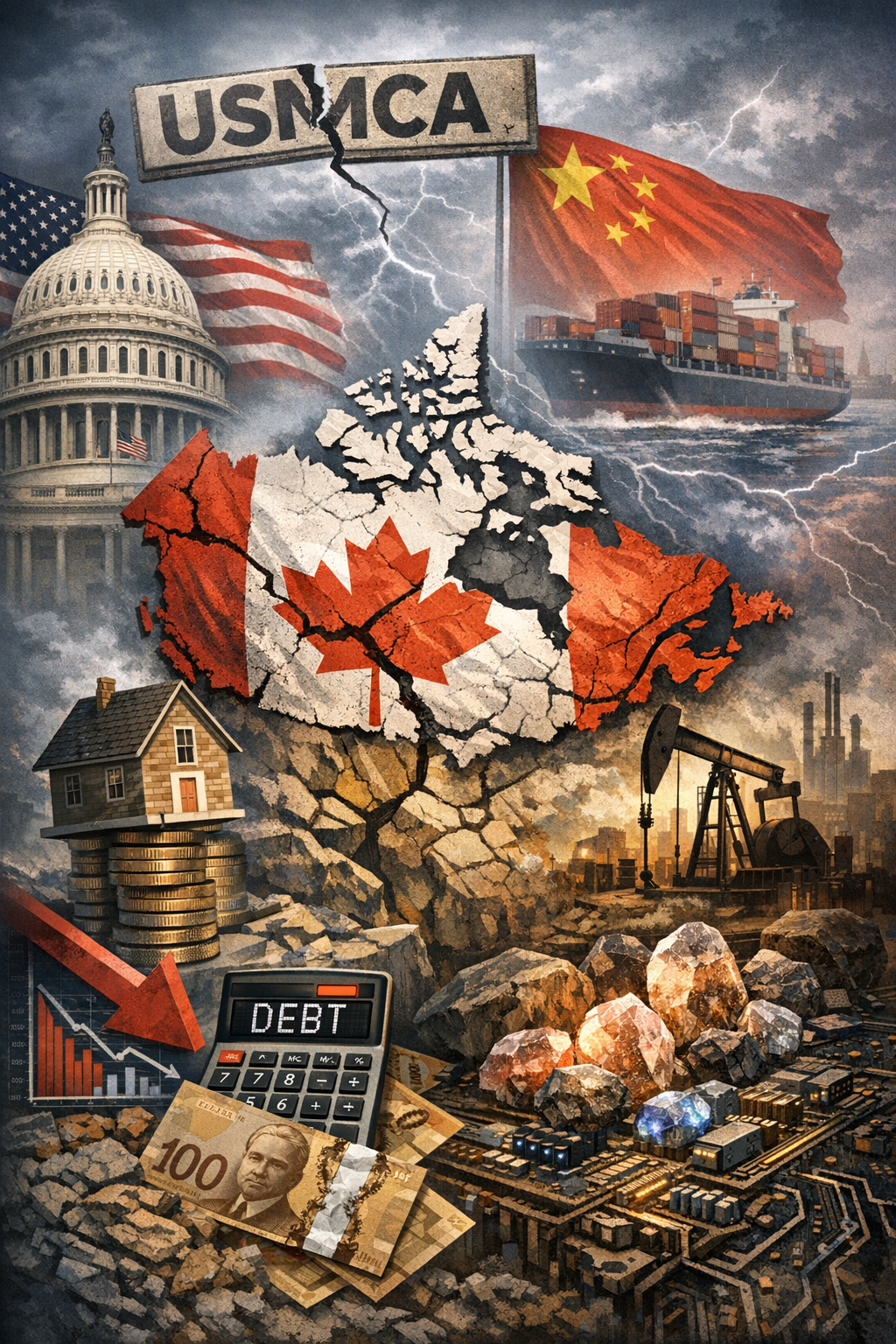
Canada as a Deferred Adjustment System: Trade Coercion, Asset Inflation, and Silent Political Stabilization
Canada is not in crisis; it is in deferral.
Under sustained U.S. trade coercion and accelerating geoeconomic fragmentation, apparent stability is maintained through asset inflation, demographic rotation, and intra-party political continuity rather than through productivity gains or strategic autonomy.
Viewed through the ODP–DFP framework, Canada operates as a force-absorbing system inside a U.S.-centric trade architecture whose rules have become conditional and asymmetric. USMCA persists legally, but its organizing power is eroding functionally. Real estate substitutes for growth, immigration substitutes for labor-market adjustment, and leadership rotation substitutes for political correction.
This configuration produces resilience on the surface while quietly degrading capital allocation efficiency, human capital retention, and long-term optionality. The risk facing Canada is not volatility, but cumulative erosion—where adjustment, once triggered, is likely to be abrupt rather than gradual.
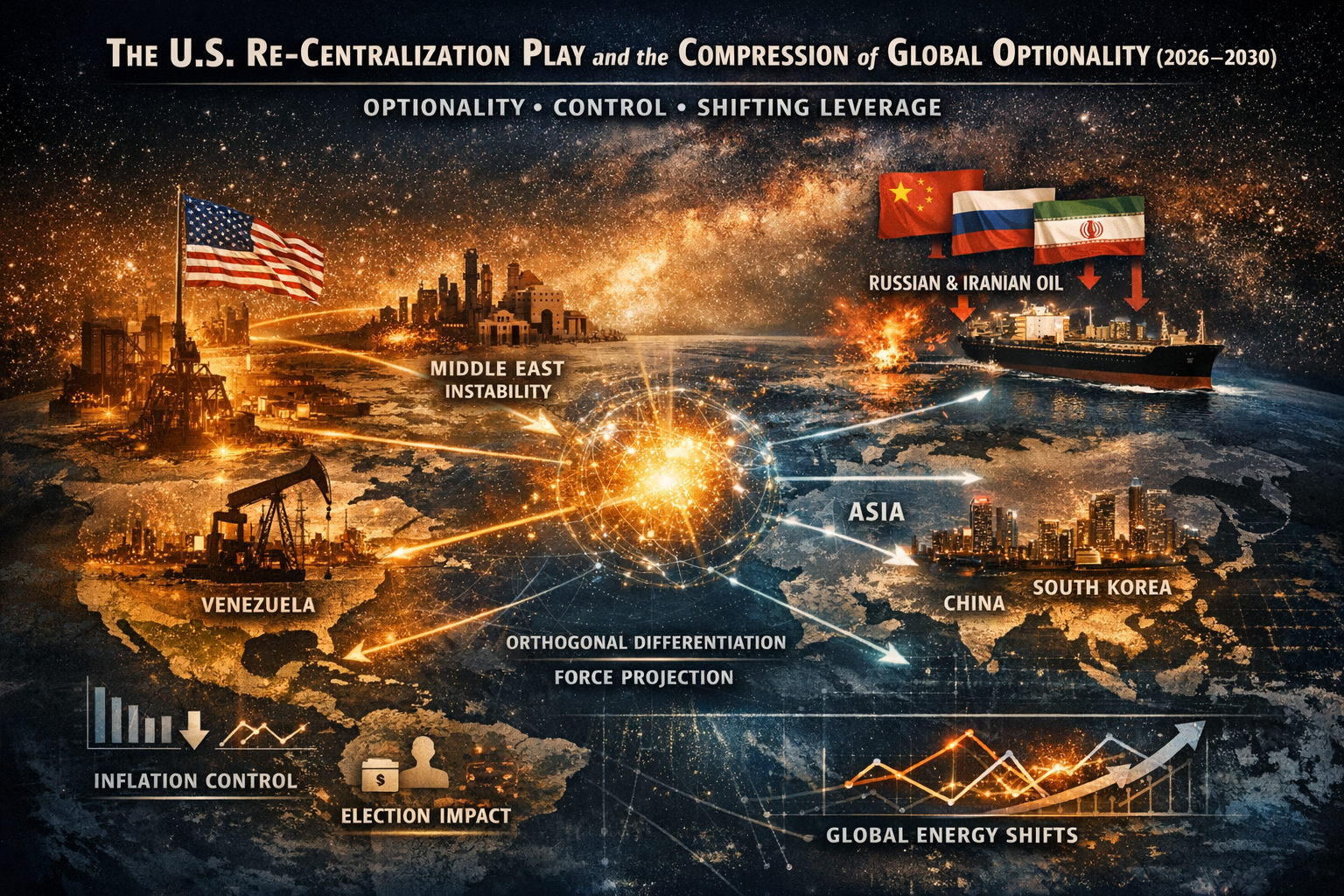
Post-Venezuela Event - Energy as Leverage
The reauthorization of Venezuelan oil flows toward the United States is not a sanctions adjustment nor a short-term supply maneuver. It marks a structural reclassification of energy within the U.S. system — from external dependency to controllable optionality.
This shift unfolds against a backdrop of declining Middle Eastern disciplinary cohesion, the erosion of China’s energy arbitrage advantage, and the rising domestic salience of inflation control inside the United States. Energy is no longer functioning as a neutral global input; it is being re-anchored as a macro-stabilization lever within a dominant absorptive system.
From an ODP–DFP perspective, the significance does not lie in volume. It lies in gradient control. By re-centralizing Western Hemisphere supply and compressing discount-driven distortions, the United States absorbs external stress while preserving outward projection capacity. Exporters face rising exposure; arbitrage-dependent systems lose asymmetry.
The global energy system appears stable because pressure is being internalized unevenly. In reality, optionality is narrowing — and structural leverage is shifting toward actors capable of absorption rather than production.
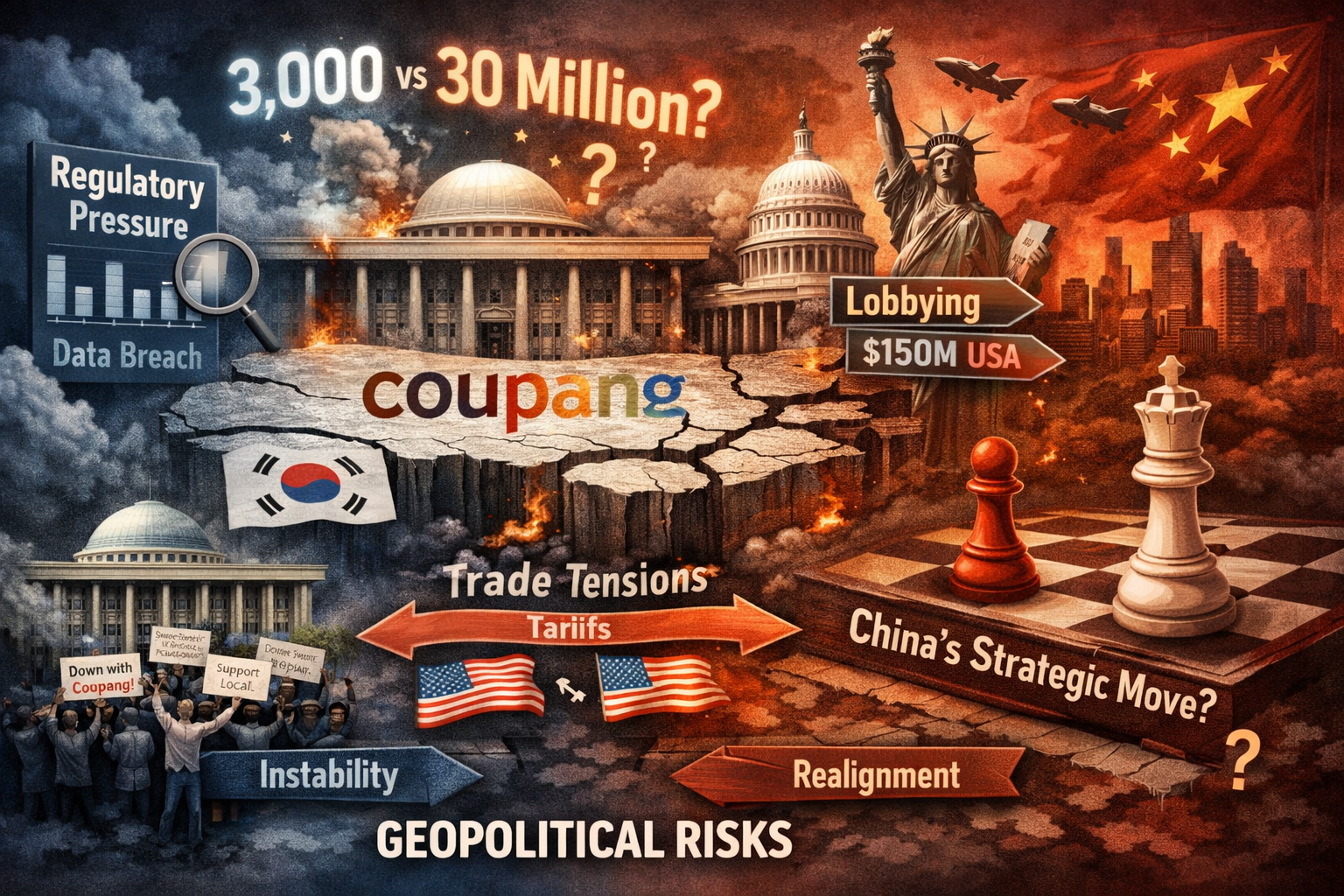
Coupang, the Korean State, and the Tariff Shadow
This episode is not a dispute about data integrity. It is a stress test of jurisdictional survival under asymmetric dependency.
Coupang’s unilateral narrative closure—reducing systemic uncertainty from “over 30 million potentially exposed accounts” to a bounded claim of “3,000 accounts recovered and deleted”—functions as a compression mechanism, not as an evidentiary endpoint. Under conditions of rising ODP exposure and low independent DFP, narrative minimization becomes the only available tool to keep regulatory activation below an existential threshold.
What appears, at the surface, as corporate defensiveness or regulatory overreach is, structurally, a collision between three misaligned realities:
where value is generated (Korea),
where legitimacy is sought (the United States), and
where optionality is preserved (China).
The system remains temporarily stable only because narrative resolution is absorbing stress faster than institutions can process it. That stability is deceptive. Structural exposure is accelerating, not converging, and no actor has yet projected sufficient force to realign the system’s internal asymmetries.
In this sense, the Coupang case is not an anomaly. It is an early signal of how platform-dominated economies fracture when revenue concentration, political legitimacy, and geopolitical leverage diverge under pressure.

Venezuela as Structural Precedent
Venezuela’s current exposure is not the result of a sudden shock or an isolated enforcement event. It is the terminal phase of a multi-decade realignment process in which sovereignty shifted from being reinforced by alignment to being asserted against it.
For much of the late 20th century, Venezuela functioned as a U.S.-aligned petrostate, economically integrated into Western markets and buffered externally despite internal volatility. That equilibrium fractured with the rise of Hugo Chávez, when alignment inverted and sovereignty was reframed as resistance. What followed was not immediate collapse, but a prolonged accumulation of structural mass: institutional rigidification, personalization of power, economic substitution, and narrative insulation.
Under Nicolás Maduro, the system entered a phase of survival without regeneration. External alignment no longer stabilized the state; it merely delayed exposure. By the time enforcement pressure intensified, Venezuela was already fully legible under stress.
This case now functions as a hemispheric signal. Sovereignty without enforceable backing no longer protects leadership. Alignment is no longer a diplomatic posture, but a structural condition that compresses—or preserves—strategic options across the U.S. sphere.
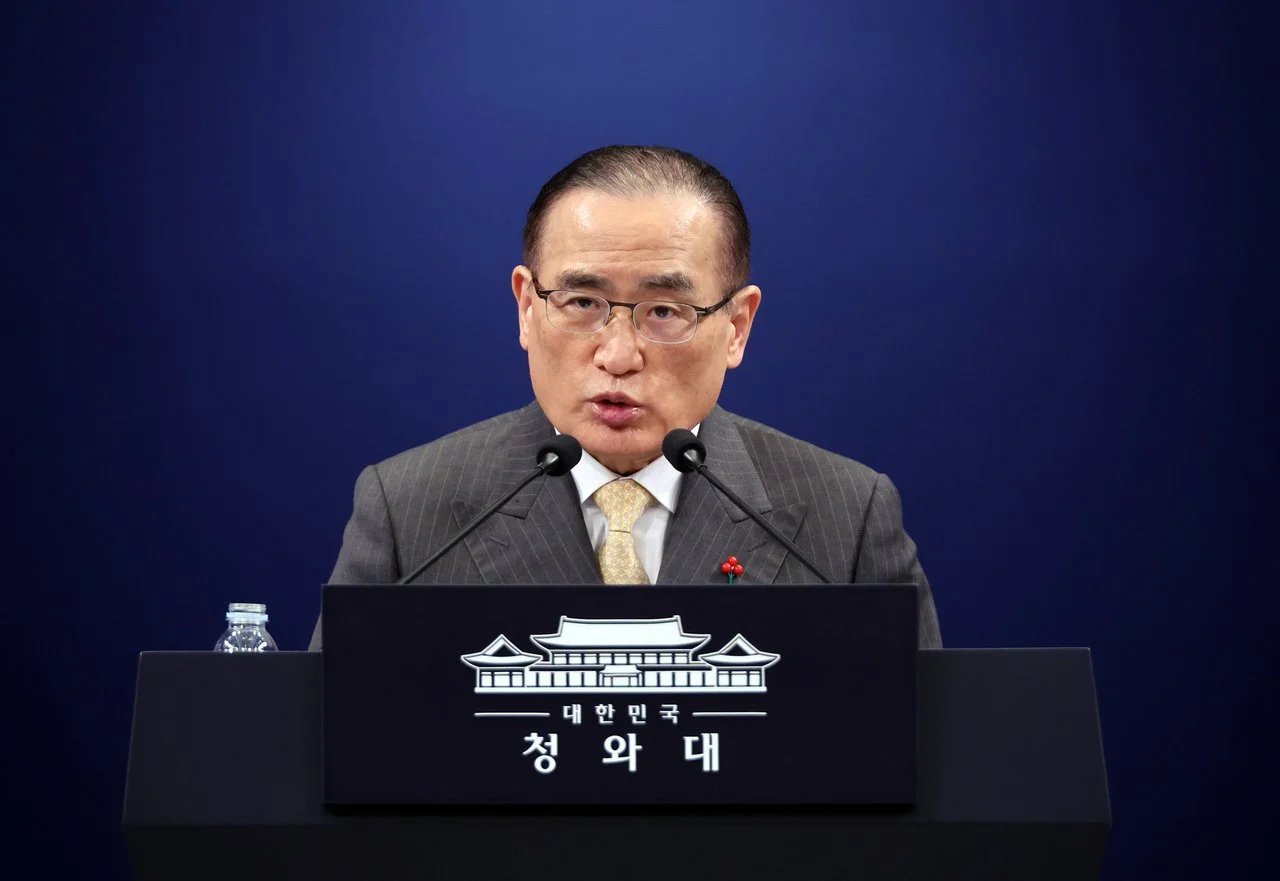
South Korea’s Pendulum State Under External Pressure
South Korea is not undergoing a diplomatic reversal, nor is it signaling a rupture in alliance structure. What is unfolding is a structural exposure event, triggered by an official Blue House declaration reaffirming respect for the “One China” principle while explicitly denying the preparation of any new Korea–China joint declaration.
This moment coincides with acute internal legitimacy stress following a nationwide platform crisis and rising external pressure from both Washington and Beijing. Under ODP–DFP analysis, the Korean state is not projecting force outward, but absorbing alignment pressure inward through narrative hardening, institutional rigidity, and symbolic sovereignty enforcement.
The system appears stable because escalation is deferred. Structural degradation proceeds not through collapse, but through a progressive loss of maneuverability, as each absorbed shock narrows the remaining adjustment corridor. South Korea is not choosing sides at this stage; it is managing exposure under constraint.
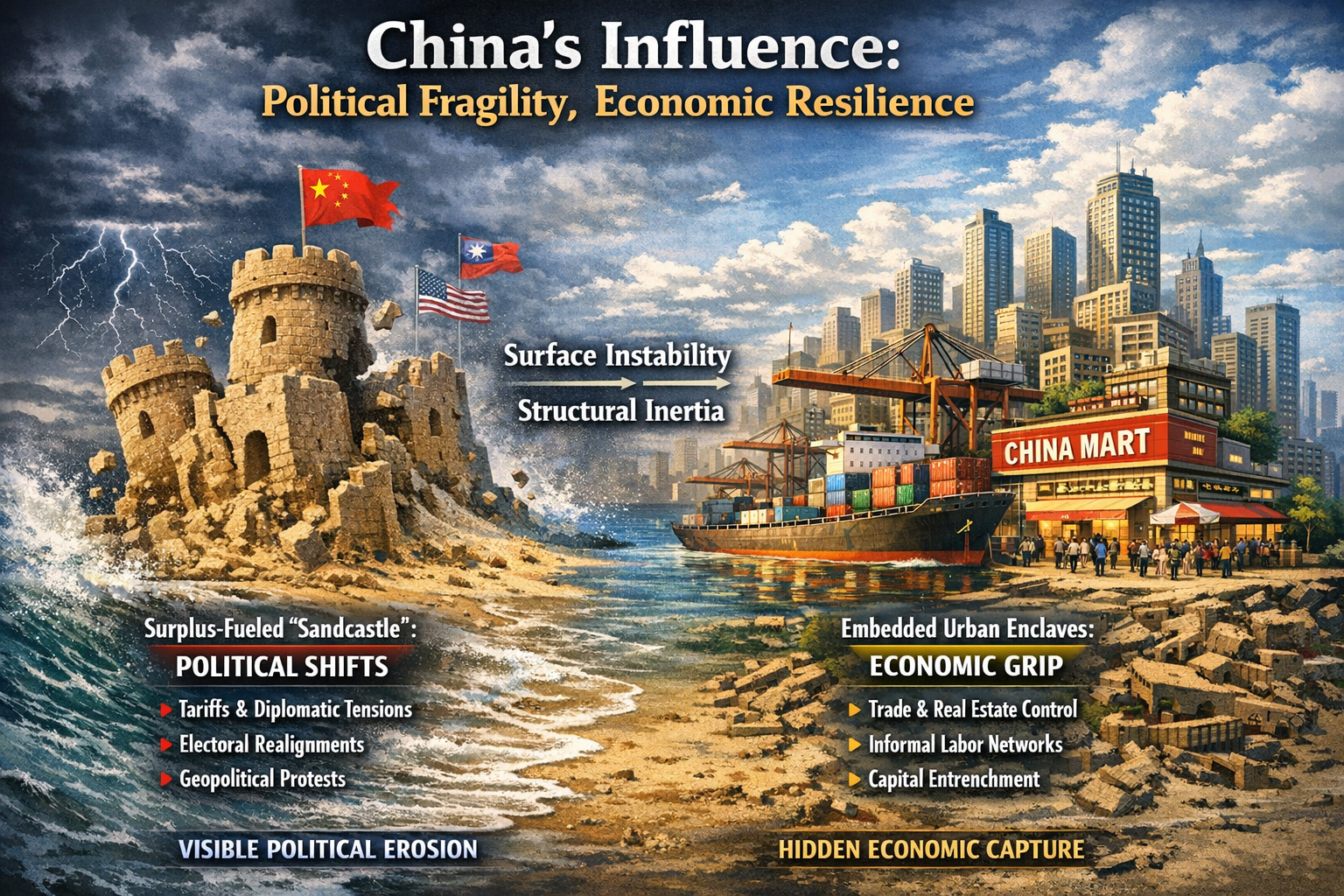
China | Political Retrenchment, Structural Persistence
China is not retreating from Latin America in structural terms. It is losing diplomatic comfort while consolidating economic irreversibility.
The dominant 2025 narrative focuses on elections, tariffs, and symbolic realignments toward Washington and Taipei. That reading captures surface friction—but misses the deeper system. When influence is disaggregated by layer, a paradox emerges: state-level alignment is shifting, yet urban economic capture continues largely uninterrupted.
Using BBIU’s ODP–DFP framework, this analysis shows why political retrenchment and structural influence are not only separable, but capable of moving in opposite directions. While China’s diplomatic force projection weakens, its embedded urban systems—retail, logistics, real estate, informal labor, and capital circuits—remain inertial, opaque, and costly to reverse.
The result is a dangerous illusion of correction: political signaling without structural intervention. History suggests that systems celebrating geopolitical “wins” while ignoring urban extraction rarely stabilize. They simply delay recognition.
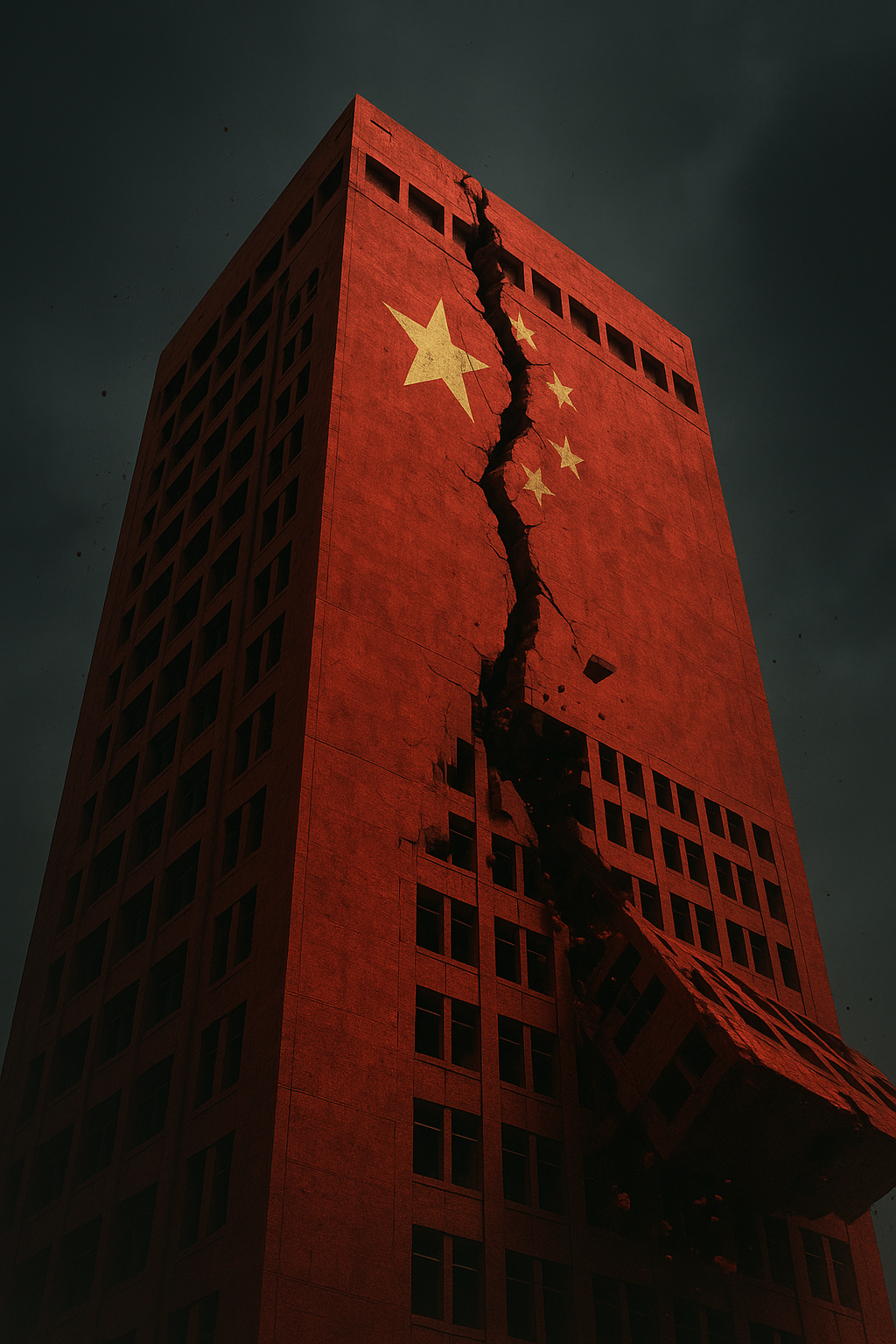
BBIU – 5th External Validation: China’s Trillion-Dollar Surplus as a Signal of Structural Exhaustion
China’s record trade surplus is being celebrated as proof of strength.
It is, in fact, the clearest evidence of structural exhaustion.
In November, BBIU argued that China’s 2025 PMI “stability” was a mirage produced by one mechanism alone: front-loaded exports pushed out in fear of Trump’s tariff wall.
The manufacturing system had not recovered — it had accelerated into a cliff.
December’s global coverage now converges on the same diagnosis:
The Economist calls China’s trillion-dollar surplus “a problem for China itself,” not a sign of dominance.
IMF repeatedly warns that China is now too large to rely on exports and must confront its internal imbalance.
Reuters confirms the full sequence BBIU published a month earlier:
front-loading → temporary PMI lift → October collapse → worst export downturn since February.
What looked like motion was depletion.
What looked like resilience was inertia.
What looked like surplus was the statistical shadow of a system running out of internal demand.
BBIU labeled this dynamic early because the ODP–DFP framework exposes what traditional indicators conceal:
China is not projecting power — China is revealing fragility.

Japan’s Silent Strike: The Photoresist Embargo, the Collapse of China’s Semiconductor Autonomy, and Korea’s Forced Alignment
China’s semiconductor future is not collapsing because of a single sanction—it is collapsing because the ecosystem required to sustain advanced fabrication has been structurally removed. Japan’s shift to prior-approval export control on photoresist and pellicles eliminates the chemical and optical lifeline that Chinese fabs cannot replace. Europe’s intervention in Nexperia dismantles China’s foothold in discrete semiconductors. ASML’s withdrawal of service after failed reverse-engineering attempts shuts down multipatterning and calibration pathways.
What remains in China are buildings, machines, engineers, and electricity—but without materials, optics, maintenance, or global trust, these assets degrade into symbolic infrastructure. The semiconductor trap is now complete: Japan closes materials, Europe closes discretes, ASML closes maintenance, and South Korea—socially and strategically—cannot rescue China without destroying its own future.
China can still produce wafers. It cannot produce tomorrow.
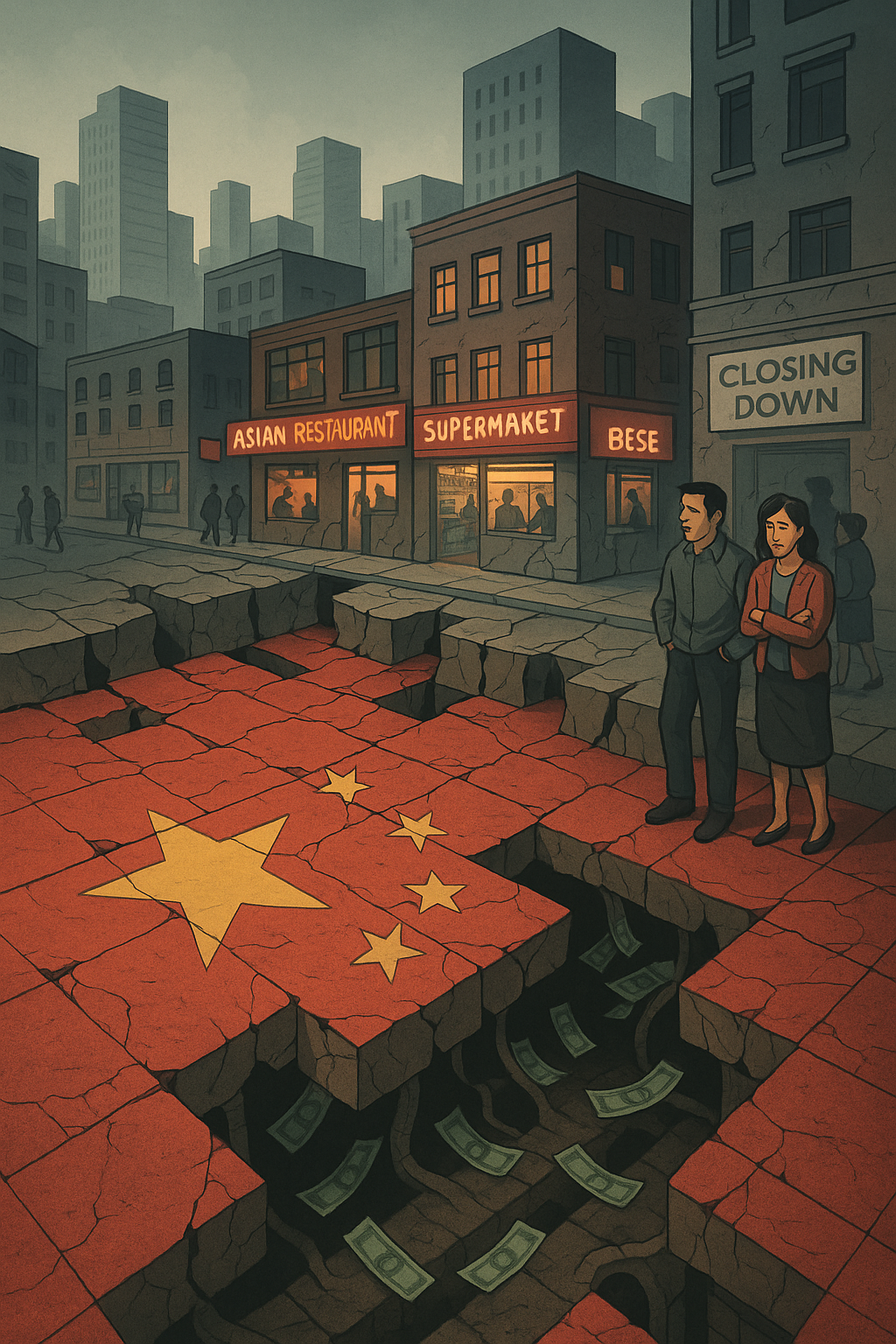
The Beautiful Illusion: How “Chinese-led Urban Revitalization” Quietly Dismantles Local Economies
What happened in Nuevo Polanco is not “cosmopolitan growth.” It is the opening move of a closed-loop economic system operating inside an open city. Beneath the new restaurants, supermarkets, cafés, and neon-lit storefronts lies a deeper architecture powered by illegal capital, illegal labor, and self-contained supply chains that bypass the local economy entirely.
The pattern is global and unmistakable: Vancouver, Buenos Aires, São Paulo, Madrid, Johannesburg, Prato, Nairobi, Luanda, Melbourne. The sequence always begins the same way — affordable food, bustling shops, cultural novelty — and always ends the same way: inflated housing, collapsed local businesses, eroded tax bases, dual economies that do not interact, and a silent extraction of value from the host city.
The danger is not the cuisine or the storefronts. It is the structure behind them: capital that is illegal at the point of origin, labor that is illegal at the point of entry, and profits that exit through invisible channels the moment they are generated. What looks like revitalization is, in reality, a long-term mechanism of dependency, hollowing cities from the inside while leaving behind only the illusion of growth.
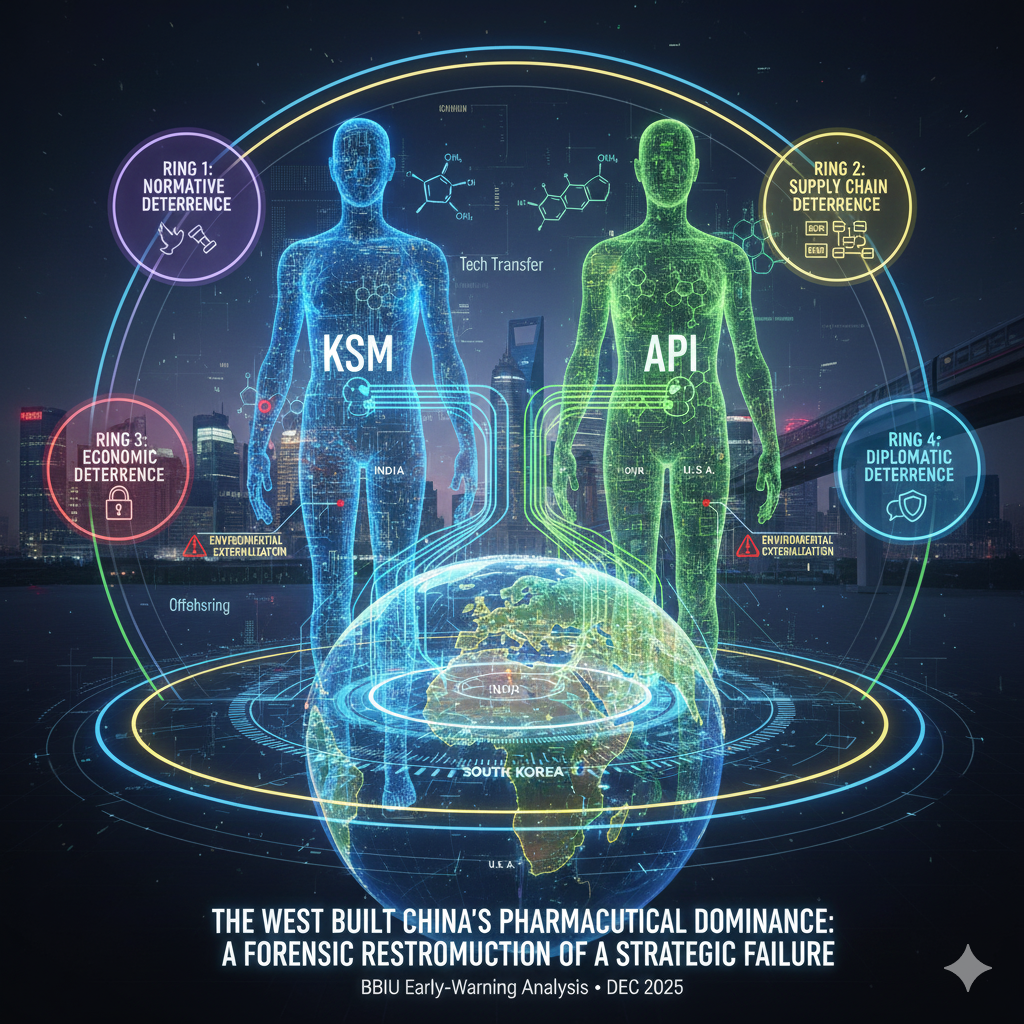
How the West Built China’s Pharmaceutical Dominance: A Forensic Reconstruction of a Strategic Failure
For decades, the world believed that pharmaceutical supply chains were global, stable, and diversified. They are not. China now controls the upstream chemical backbone of modern medicine — the Key Starting Materials (KSMs) and Active Pharmaceutical Ingredients (APIs) that every country depends on. This dependence did not emerge overnight; it was built through decades of Western offshoring, environmental outsourcing, and the silent transfer of industrial know-how. Today, the world faces a single point of failure in the one sector no nation can afford to lose: medicine.
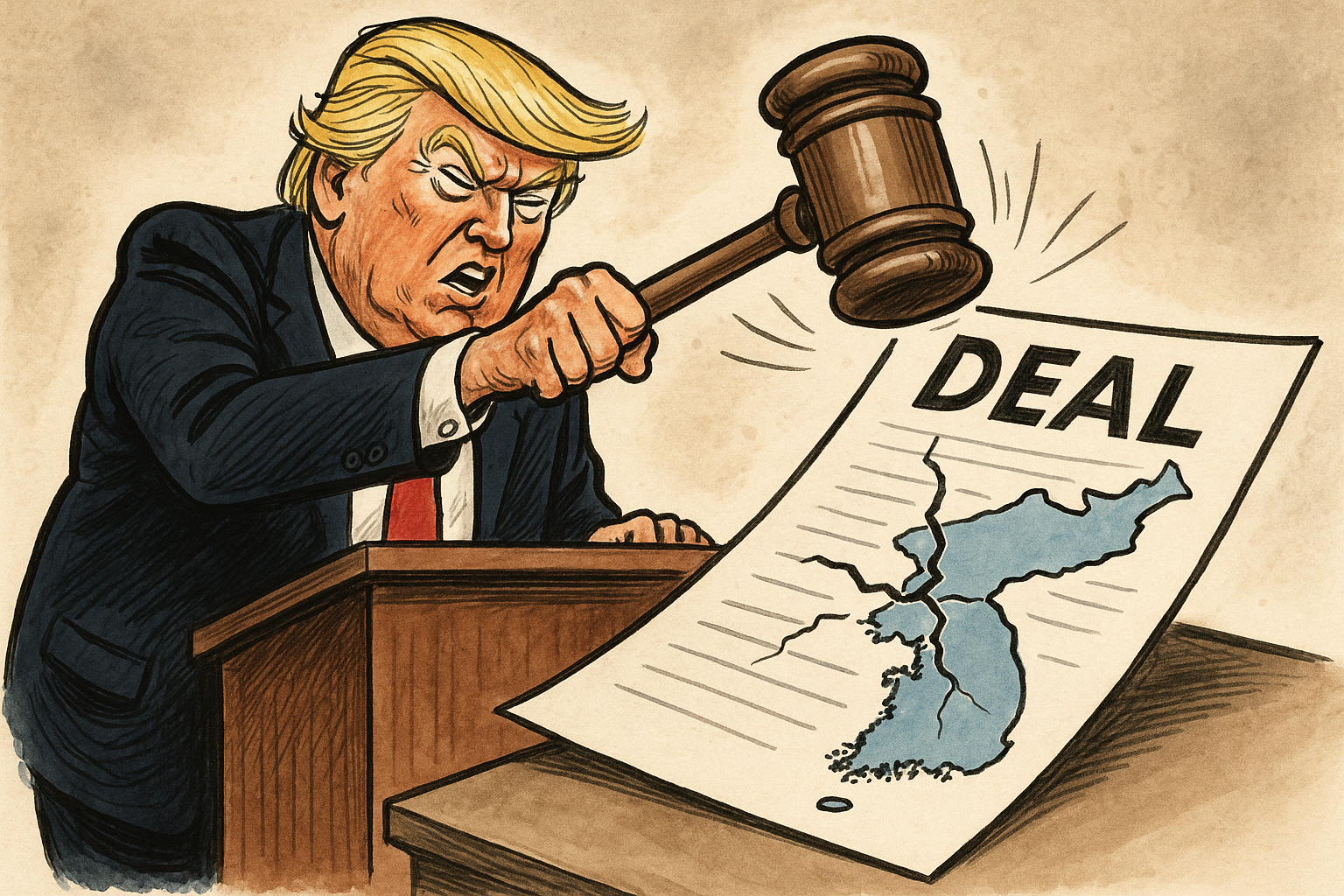
The White House Blow-Up: Why Trump’s Disphonic Outburst Points to South Korea as the Target of His Trade Fury
Five days ago, at the White House, Donald Trump delivered a press briefing where he appeared visibly exhausted and spoke with a strained, almost broken voice. Half in jest and half in warning, he said he had lost his voice “screaming at people who were stupid” about a trade deal already agreed to — but now being renegotiated. While early speculation pointed toward Australia or Canada, BBIU’s structural analysis shows that only South Korea fits every detail of the timeline, conditions, and symbolic context.
In Trump’s worldview, a verbal commitment spoken on U.S. soil — the $350B investment pledge announced publicly by President Lee on July 30 — constitutes a binding contract. In Seoul’s political culture, however, spoken commitments are provisional and renegotiable. This mismatch transformed diplomacy into punishment. Korea believed that delaying would weaken pressure; instead, Trump weaponized time. His recent remark about being “tired of what happened in Georgia” was not about immigration enforcement — it was a declaration that the grace period has expired. The confrontation has now shifted from negotiation to symbolic discipline, and Korea is the demonstration case.
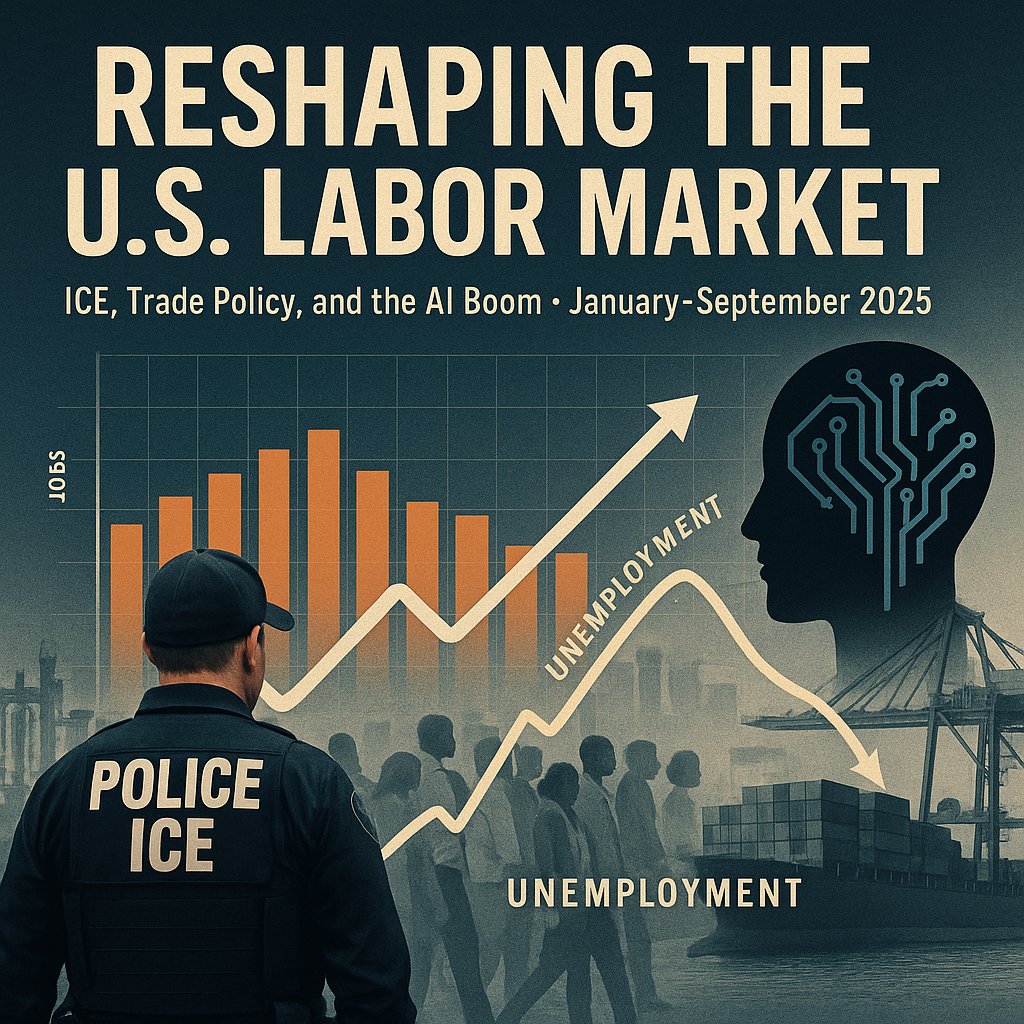
The ICE Shock: How Migrant Enforcement Is Reshaping U.S. Labor Dynamics, Price Structures, and Long-Term Formalization
From January to September 2025, the United States experienced the most profound labor realignment in its recent history. A massive ICE enforcement wave quietly removed more than two million undocumented workers from sectors that had depended on them for decades. At the same time, tariffs reshaped supply chains and the federal government elevated AI to the category of national infrastructure. These forces collided to produce what looked, at first glance, like a contradiction: rising non-farm payrolls alongside rising unemployment. But the pattern was not contradictory—it was the signature of a system being reorganized from the inside. Firms struggled through a short period of disruption, then began replacing invisible labor with formal workers, pushing payrolls up while temporarily elevating unemployment. What emerged was a labor market that is more transparent, more expensive, and structurally more dependent on AI-driven productivity than ever before.
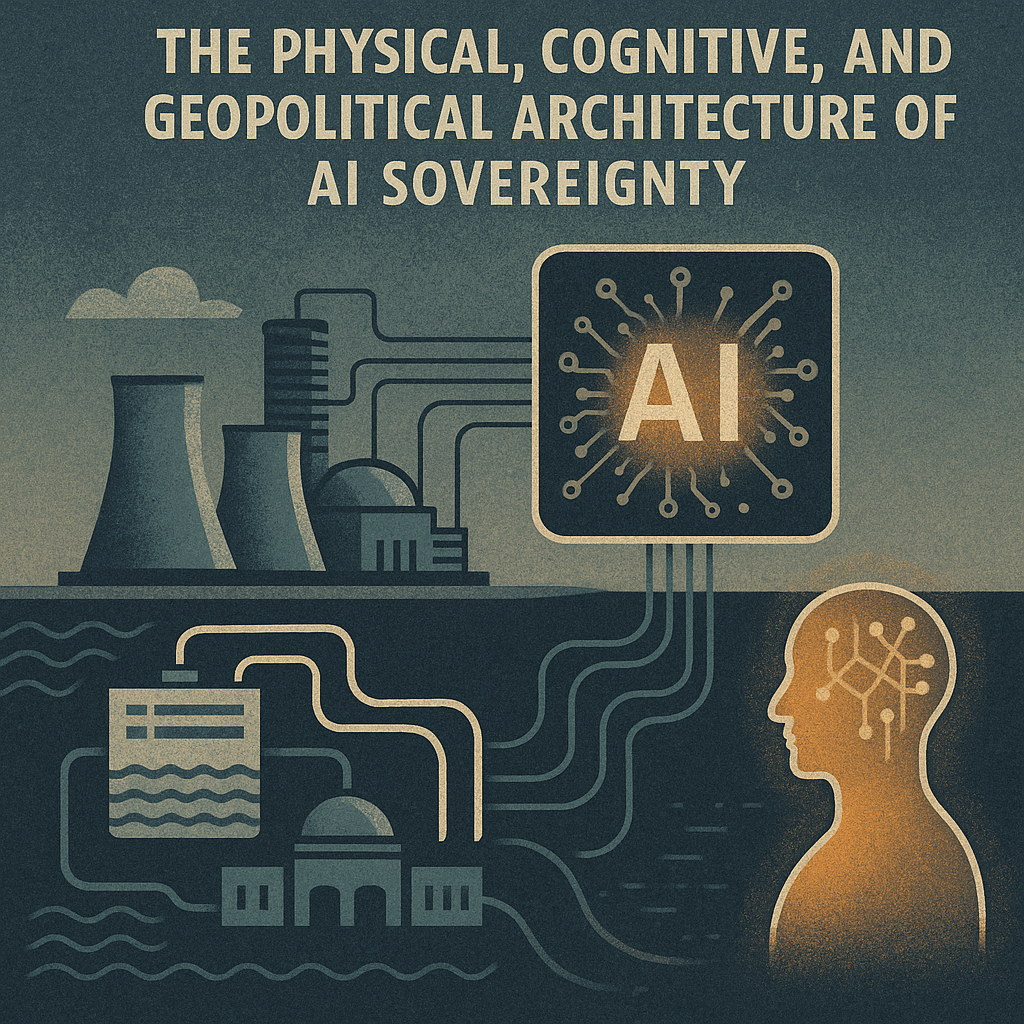
SC | The Real Competitive Frontier: Why Edelman’s 20-Million Theory Is Incomplete, and Why AI Power Depends on User Type, Not Population Size
Artificial intelligence does not equalize nations; it stratifies them. The core oversight in Edelman’s statement is the assumption that “20 million people who use AI correctly” exist anywhere. Productivity does not scale with population size but with the density of high-tier cognitive operators—Frontier, Architect-Symbiotic, and Ultra-Frontier users capable of imposing structure, correcting drift, and directing models as strategic instruments. BBIU’s analysis shows that a small nucleus of Ultra-Frontier operators can generate national-level leverage that millions of low-tier users cannot replicate. When combined with sovereign energy, subterranean compute architecture, and nuclear-driven water and cooling loops, this cognitive layer becomes a force multiplier unequaled in previous technological eras.
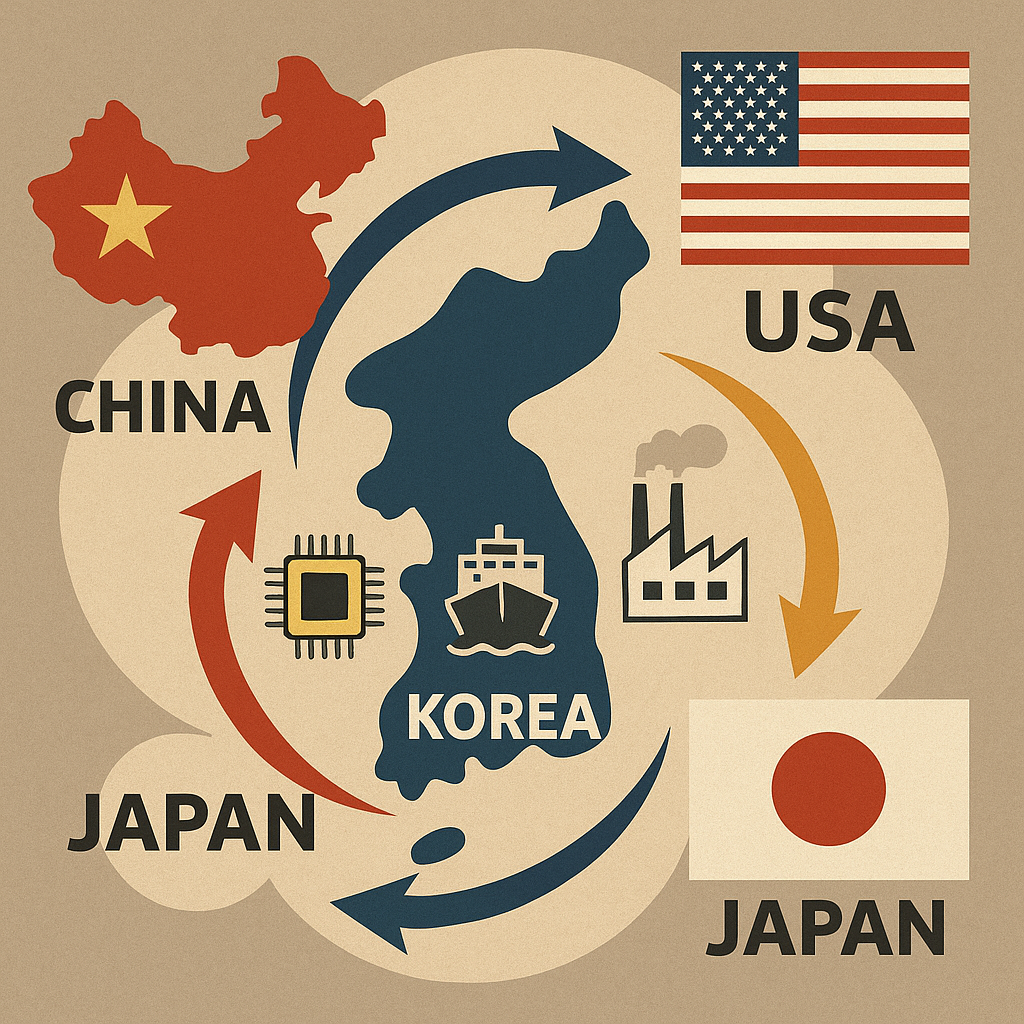
SK Hynix’s ₩600 Trillion Bet: Korea’s Silent Struggle Against Strategic Extraction
South Korea today is more than a nation-state—it is an active front in a geopolitical contest fought not with missiles, but with capital flows, tariff regimes, semiconductor fabs, and nuclear submarine promises. Under intense U.S. pressure, Korea exports its industrial core—semiconductors, shipbuilding capital, biologics—into American soil, receiving in return conditional market access and politically fragile reassurances. Meanwhile, China seeks to preserve Korea’s appearance of sovereignty while turning it into a functional dependency—a “zombie” state controlled through rare earth leverage and asymmetric economic ties. Japan, for its part, quietly positions itself as the ultimate winner: exporting ultrapure semiconductor materials into U.S. fabs while welcoming the erosion of Korea’s domestic industrial gravity.
The ₩600T Yongin announcement is not a display of confidence—it is a survival maneuver. A rhetorical mirror held up to foreign demands. Korea stands increasingly disassembled into functions: a factory for the U.S., a captive market for China, and a downstream channel for Japan. A battlefield without bullets, defined by the rearrangement of power through contracts, production shifts, and the quiet capture of sovereignty itself.
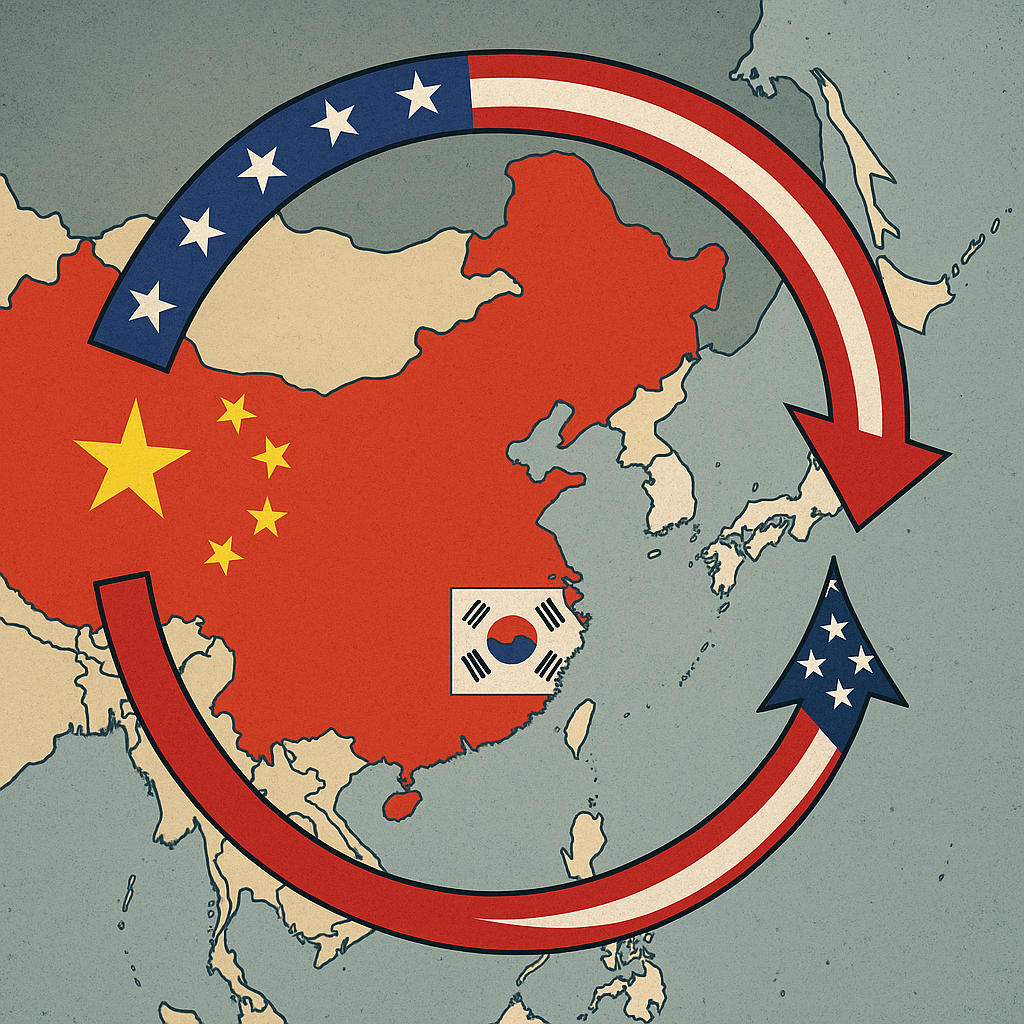
The Nuclear Illusion: What South Korea Is Not Being Told About the U.S.–Korea Pact
South Korea celebrates a nuclear submarine ‘approval’—but the vessel will be built in the United States, fueled under U.S. legal control, and funded by Korean capital. This is not autonomy; it is a dependency pact dressed as strategic partnership. The real victory is Washington’s: Korea raises its military spending to 3.5% of GDP, injects $150 billion into U.S. shipyards, and imports a platform it cannot build or command alone
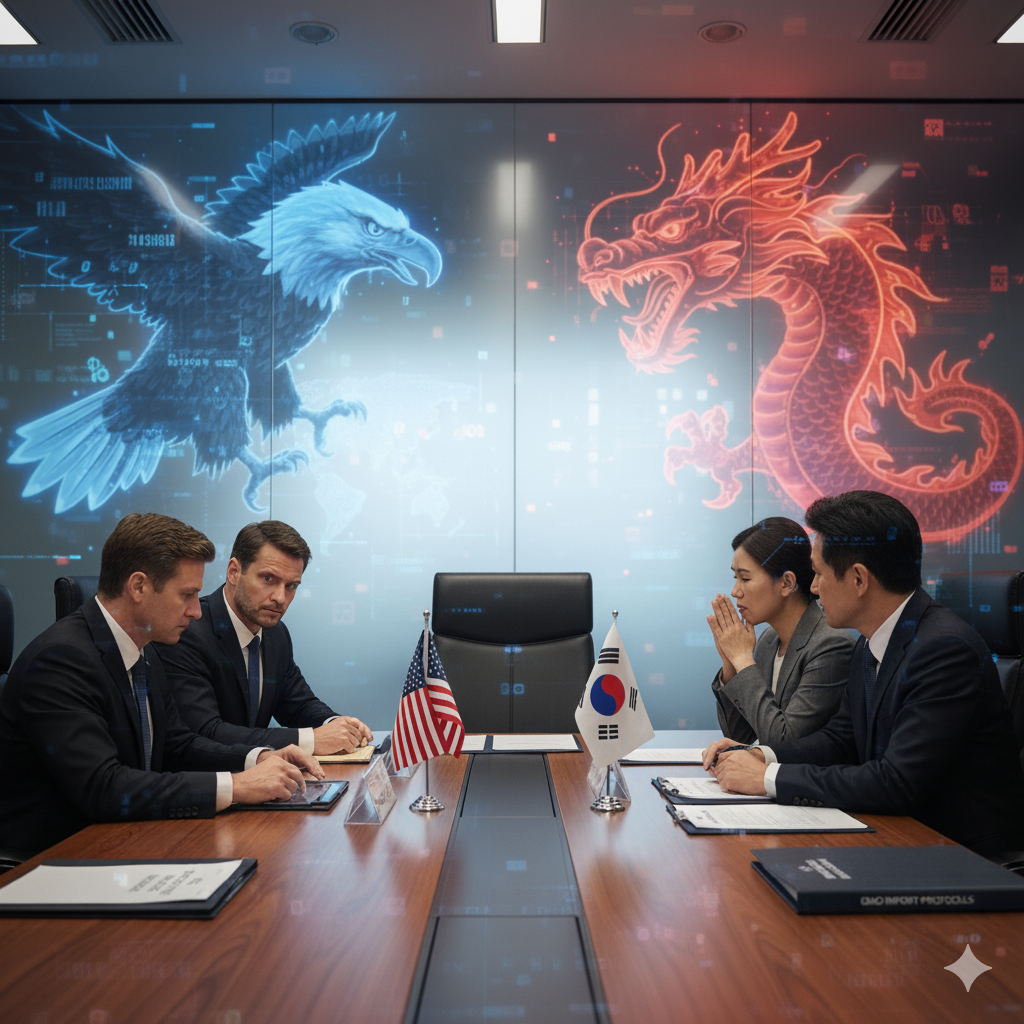
Extraction Confirmed: Korea’s Regulatory Concessions Mark the Fulfillment of a U.S.-Engineered Capital Realignment
“South Korea has crossed the threshold from negotiation to submission. What began as a tariff adjustment has now spiraled into a structural recalibration of sovereignty, culminating in the insertion of a ‘U.S. Desk’ into the nation’s agricultural governance. This is not cooperation—it is regulatory annexation. Korea’s food security, environmental protections, and industrial autonomy are now vectors of external control. The silence of July has matured into the erosion of November.”
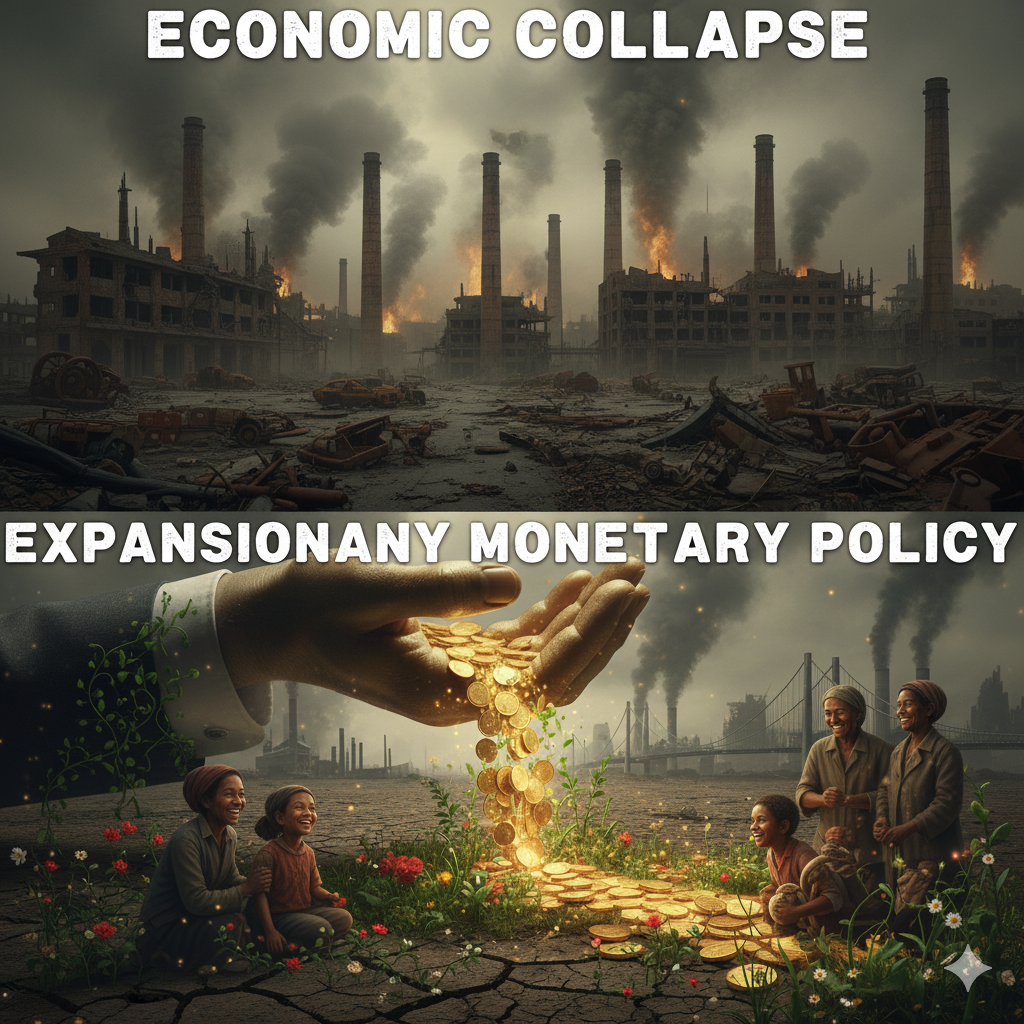
Korea’s Coming Inflation Wave (2026–2027)
Korea is not experiencing the inflation of this government — it is experiencing the delayed echo of decisions made 18–24 months ago. The real price shock, the one structurally embedded in the ₩100-trillion deficits and the industrial retreat toward the United States, will arrive between late 2026 and mid-2027. And when it does, it will hit a population facing a double blow: rising prices with no wage growth.
With no U.S. dollar swap, a politically conditional China swap, and a collapsing domestic industrial base, Korea enters this period with no independent stabilizer. The future inflation is already in the system; it simply has not fully surfaced yet.
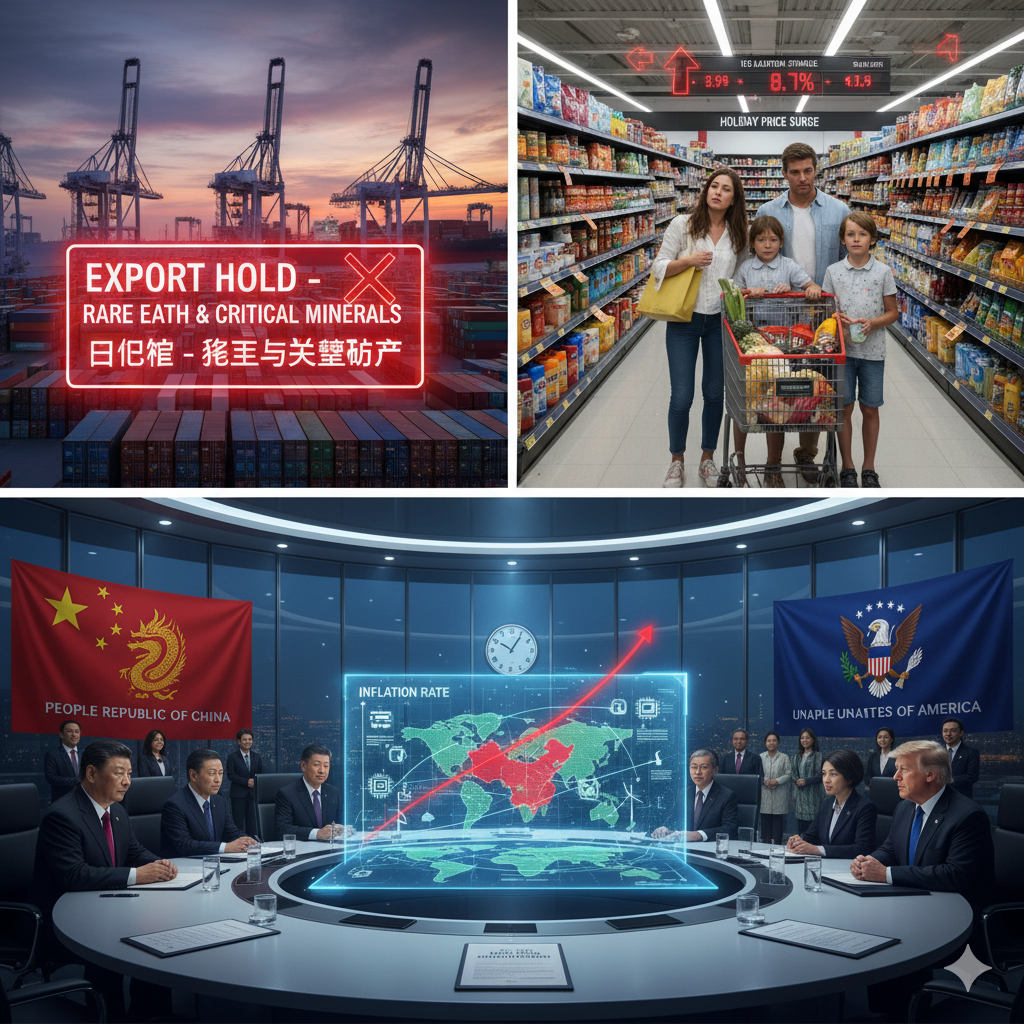
From Coercion to Conditional Compliance: China’s Export-Control Retreat and the U.S.–Allies Strategic Pivot (Oct 9 – Nov 9, 2025)
Between October and November 2025, China attempted to weaponize its dominance over critical materials — and discovered the limits of coercive leverage in a coordinated global system. The one-year suspension of export controls on gallium, germanium, antimony, and rare earths marks not reconciliation but exhaustion: Beijing traded geopolitical pressure for domestic liquidity.
For the United States, the timing was perfect. As the Western holiday purchase cycle accelerated, Washington gained both cheaper imports and a disinflationary narrative. The Xi–Trump truce transformed China’s leverage into a timed concession — a one-year bridge until U.S. and Australian refining capacity reaches scale in late 2026.
The outcome is asymmetrical yet coherent: China preserved liquidity; the United States captured time. What appears as a tactical truce is, in structural terms, the redefinition of economic sovereignty through control of industrial calendars.
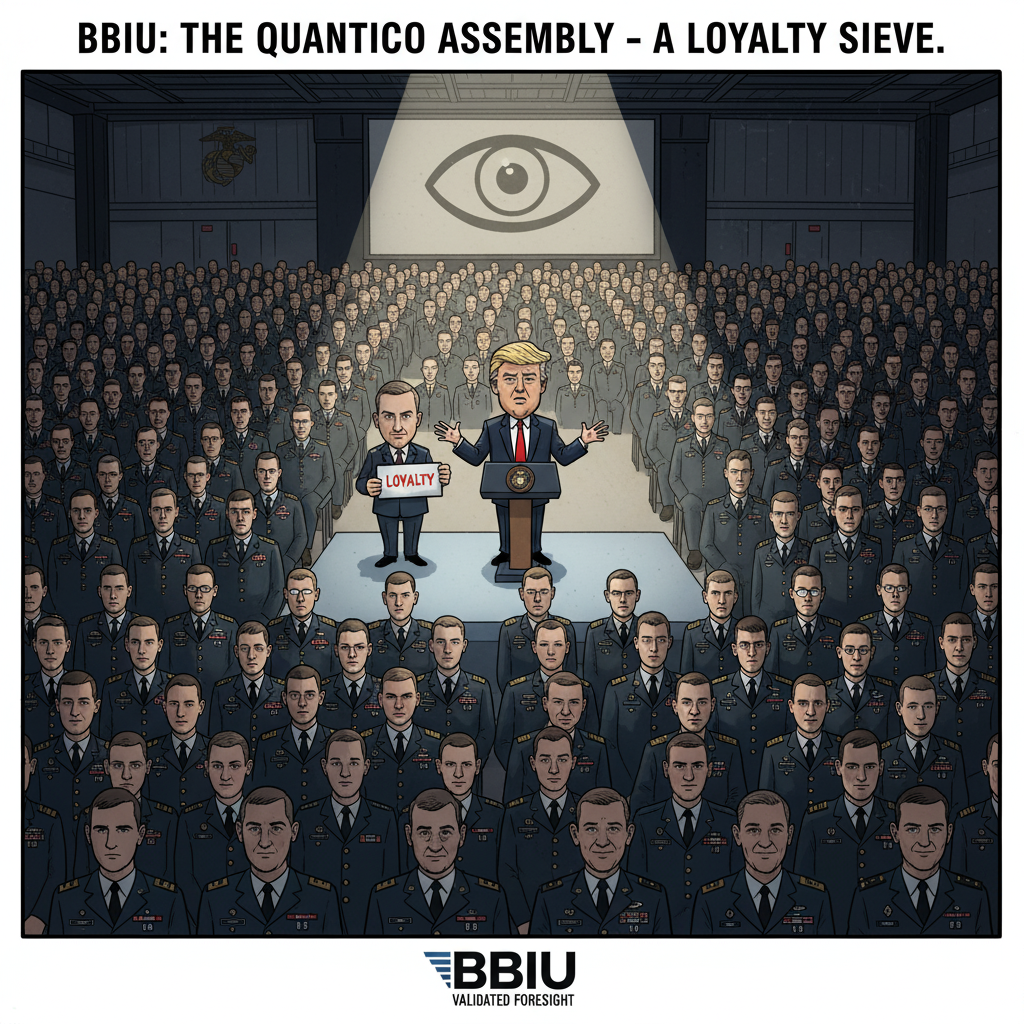
The Quantico Tamiz – How the New York Times Confirmed BBIU’s October Projection
On November 7 2025, The New York Times reported that Defense Secretary Pete Hegseth had “fired or sidelined at least two dozen generals and admirals over the past nine months.”
This revelation confirms what BBIU projected more than a month earlier, in its October 3 analysis “The Quantico Assembly: Trump’s Silent Tamiz of the U.S. Generals.”
What mainstream media now describes as a “purge” was identified by BBIU in advance as a filtration mechanism — a deliberate, data-driven process of ideological alignment within the U.S. military command.
The subsequent removal of roughly twenty senior officers validates BBIU’s structural forecast that the September 30 Quantico meeting marked the beginning of a controlled reconfiguration of military power under the Trump-Hegseth axis.
BBIU’s foresight is now independently confirmed: Quantico was not a motivational gathering, but the first stage of an institutional purge disguised as reform.
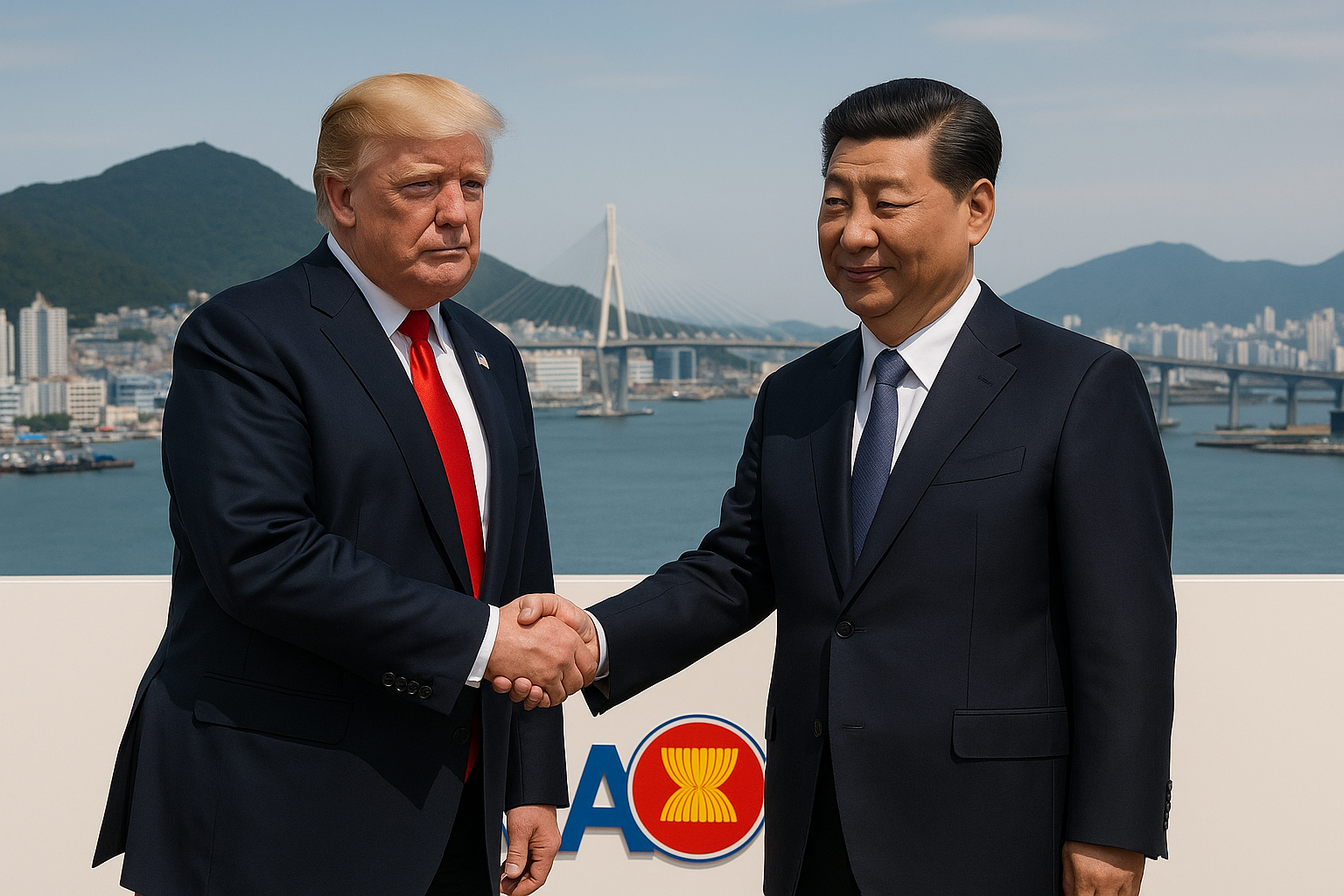
The Xi–Trump Summit: Tactical Truce, Structural Submission
The Busan summit between Donald Trump and Xi Jinping marked a temporary stabilization in U.S.–China relations but confirmed a deeper asymmetry in power and intent.
Under the appearance of cooperation, Washington achieved three objectives: regaining agricultural leverage, securing rare-earth supply for one year, and preserving full control over semiconductor restrictions.
Beijing, constrained by deflation, youth unemployment, and capital flight, accepted the truce as a survival measure rather than a strategy.
The one-year duration of the rare-earth clause synchronizes perfectly with the U.S.–Australia industrial corridor’s completion, allowing Washington to reassert dominance once independence is achieved.
Technological containment remains untouched; economic relief is symbolic.
Busan, therefore, was not diplomacy—it was orchestration: a handshake masking a hierarchy, a truce that encodes submission.
Annex A – Technical and Industrial Evidence: Semiconductor Controls and the ASML Incident
Annex B – The Rare-Earth Corridor and the Ten-Point Tariff Illusion
Annex C – Internal China: The Causes and Conditions Behind the Busan Concession