

Capricor–Deramiocel: When Unresolved Clinical Risks Become a Corporate Crisis
Capricor’s deramiocel rejection illustrates how unresolved scientific uncertainties, immunological risks, underpowered trials, and statistical governance failures can escalate into a corporate crisis. By tracing critical decisions from preclinical development through Phase III, BBIU examines the missed opportunities to correct course—and why independent critical assessment matters before clinical uncertainty becomes irreversible financial risk.

The Co-Scientist Validation Gap: Are We Measuring AI Capability or Human–AI Performance?
How much of AI-driven scientific performance comes from the model itself, and how much depends on human expertise?
Building on a recent Nature Medicine study of OpenScientist, BBIU examines how iterative human guidance, inconsistent experimental conditions, and agentic architecture complicate the attribution of scientific results. We propose a controlled validation framework to distinguish autonomous AI capability, architectural value, and human–AI interaction—prioritizing scientific validity, reproducibility, and measurable research value.
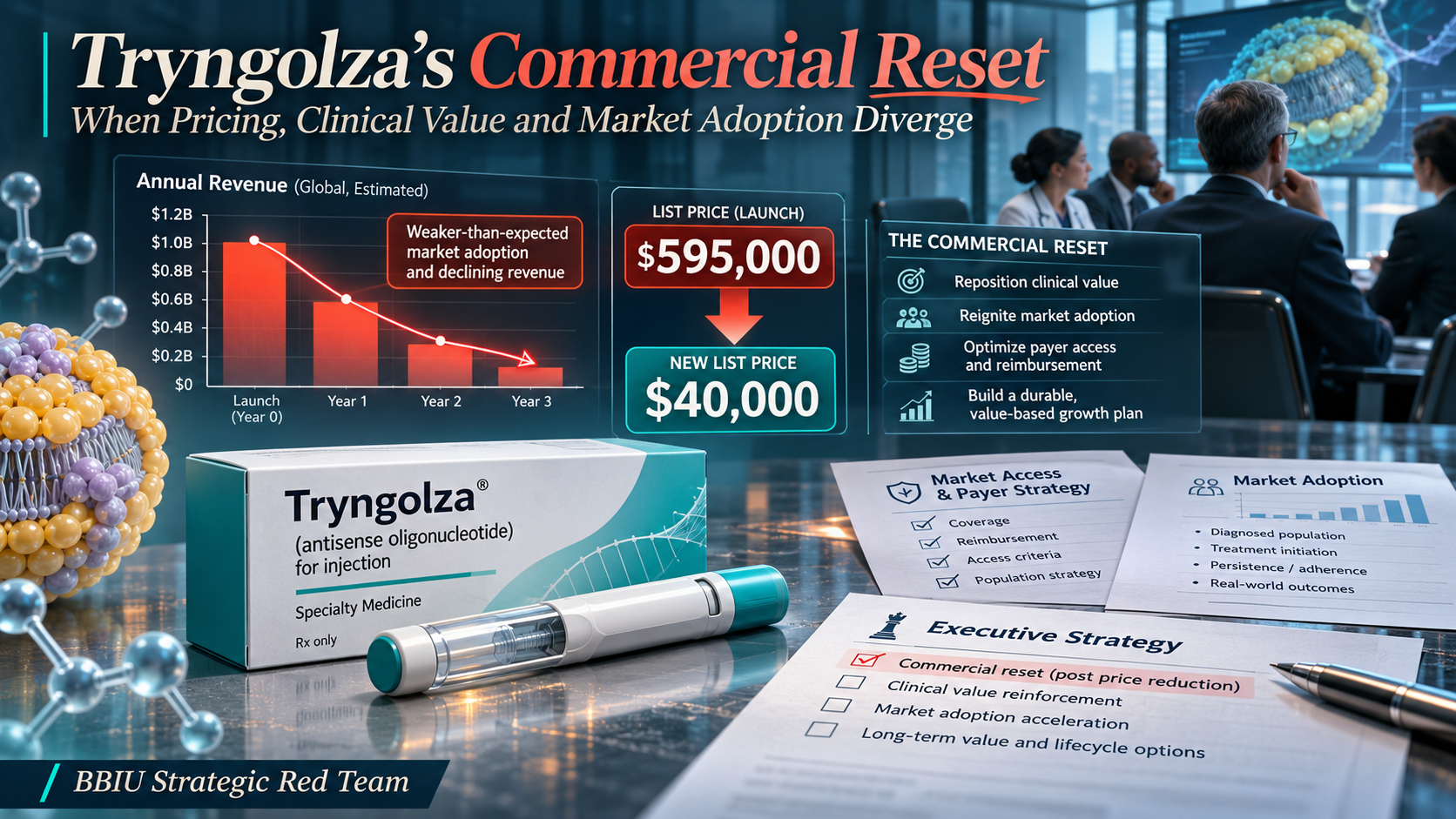
Tryngolza’s Commercial Reset: When Pricing, Clinical Value and Market Adoption Diverge
Ionis Pharmaceuticals’ 93% price reduction for Tryngolza, followed by a sharp downgrade in sales guidance, exposes a critical disconnect between clinical efficacy, pricing strategy, and market adoption. BBIU examines the commercial and clinical decisions behind the reset, the potential value of cardiovascular outcomes development, and the assumptions executives should challenge before committing further capital.

Vitiligo Therapeutics 2026: Positive Phase III Trials, Intensifying Competition, and the Reimbursement Challenge
The global vitiligo treatment market, estimated at $1.6–1.9 billion in 2026, is entering a new competitive phase. AbbVie has secured European approval for upadacitinib, while Pfizer and Incyte have reported positive Phase III results for competing systemic therapies. Teva is advancing an alternative biological approach. Yet clinical success does not guarantee commercial value. Differences in efficacy, long-term immune safety, regulatory positioning, and reimbursement will determine which treatments gain sustainable market share. BBIU examines the competitive landscape, the limits of the addressable systemic treatment market, and the strategic challenges facing pharmaceutical executives.
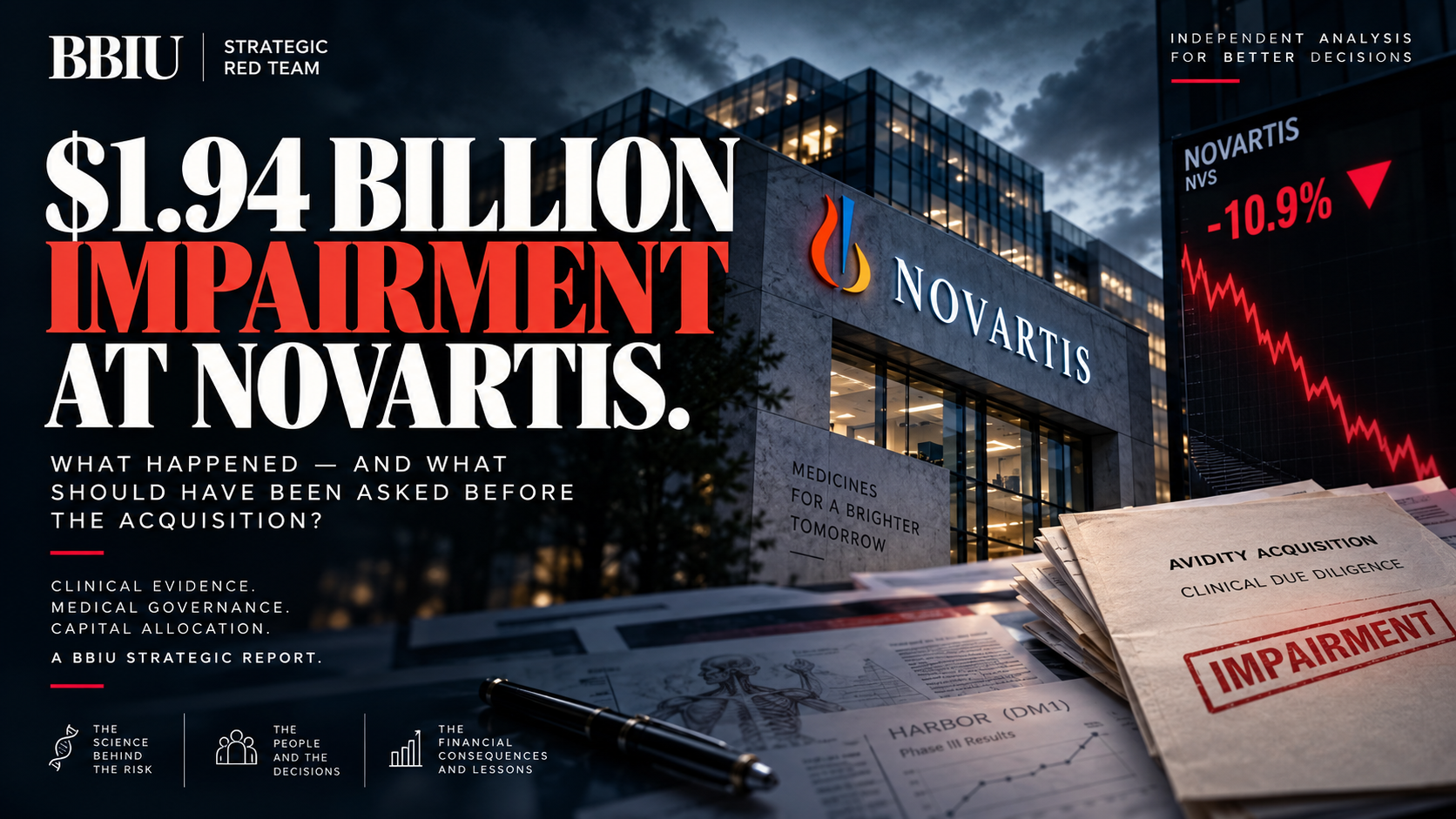
Novartis and the $1.94 Billion Impairment: The Cost of Unchallenged Clinical Assumptions
Novartis’s $1.94 billion impairment following the failure of Avidity’s Phase III HARBOR trial raises questions beyond clinical efficacy. Examining the evidence, development decisions, and medical governance across HARBOR, NATALEE, and MONALEESA, this BBIU Strategic Report explores whether critical scientific uncertainties were sufficiently challenged before major financial commitments. The case illustrates the strategic value of independent Red Team assessments in clinical development, pharmaceutical acquisitions, and capital allocation.
Challenge Your Assumptions. Before You Decide.

U.S.–China Biopharma Partnerships: Commercial Value, Technology Control, and Long-Term Strategic Risk
As U.S. restrictions on outbound biotechnology investment expand, Western pharmaceutical companies are deepening partnerships with Chinese innovators. BBIU examines the commercial opportunities alongside long-term risks involving technology transfer, sovereign jurisdiction, competitive displacement, and executive incentives. The central question is whether today's partnerships create sustainable value—or strategic dependencies that future management teams will inherit.

NEJM - NHS: Galleri - Early Detection Only Matters If Diagnosis Follows Fast
Galleri may detect a cancer signal early, but early detection only creates value if the path to definitive diagnosis is equally fast. This analysis examines whether organ localization and further molecular characterization from the initial blood draw could reduce unnecessary imaging, shorten diagnostic delays, and preserve the time advantage that multi-cancer screening is meant to create.

FDA: Zilganersen in Alexander Disease: Clinical Evidence, Lifetime Economics, and Strategic Decisions
Zilganersen’s approval introduces a new treatment for Alexander disease—and a long-term commitment to repeated intrathecal administration. This analysis connects astrocyte biology and clinical evidence with procedural burden, lifetime expenditure, opportunity cost, and market potential, examining what payers, healthcare leaders, and investors need to know as durability and survival benefits remain uncertain.

FDA:Daraxonrasib and the Expansion of RAS-Targeted Therapy
Daraxonrasib represents a genuine therapeutic breakthrough in metastatic pancreatic cancer. In RASolute 302, median overall survival reached 13.2 months versus 6.7 months with chemotherapy, while median progression-free survival increased from 3.6 to 7.2 months. Yet the FDA label extends beyond the trial’s strongest evidentiary foundation: 91.8% of participants had RAS G12-mutated tumors, evidence outside this population was limited and discordant, and treatment-naive patients unable to receive multiagent therapy were not directly studied. At a wholesale acquisition cost of USD 39,800 per 30-day supply, these uncertainties become questions of opportunity cost. This BBIU Strategic Report examines whether a biomarker-independent indication can sustain the same clinical and economic expectations across its full population—and what healthcare systems may have to forgo to finance broad access.

Korean Biotech Is Not Always Selling Drugs — It Is Selling Transferable Development Packages
Korean biotech companies often create value not by commercializing drugs themselves, but by building transferable development packages for global out-licensing. This article examines why short-term savings in CMC, QA, QC, E&L, regulatory strategy, and process traceability can create far greater downstream costs—through remediation, delays, due-diligence uncertainty, and reduced asset value. The central lesson: the cheapest development path is not necessarily the lowest-cost path.

FDA, Before Competency Comes Necessity: The Hidden Liability of Integrating Generative AI into Medical Devices
The FDA is asking how generative AI-enabled medical devices should be evaluated. But before testing competency, regulators must answer a more fundamental question: why does the medical function require GenAI, and why must it be integrated into the device? This BBIU Institutional Analysis examines manufacturer accountability, third-party model dependency, irreversible patient-data exposure, systemic risk, and a patient-controlled alternative.

Finerenone Beyond Diabetic CKD
FIND-CKD establishes that finerenone can slow kidney-function decline beyond diabetic CKD, but it does not resolve the larger clinical and economic question. The statistically robust difference of 0.7 ml/min/1.73 m² per year translates into only approximately 1.9 eGFR units preserved over 32 months, while both groups continued to deteriorate. With limited baseline SGLT2-inhibitor use, increased hyperkalemia, and substantial acquisition costs, the evidence supports targeted regulatory expansion more clearly than unrestricted reimbursement or broad commercial extrapolation.

GoGoVax’s Phase 3 Failure and the Evidence Gap Behind Gonorrhoea Vaccination Policy
The Phase 3 GoGoVax trial found that GSK’s 4CMenB vaccine, Bexsero, did not reduce gonorrhoea incidence despite earlier observational evidence suggesting partial cross-protection. The result exposes a broader translational gap: serum bactericidal immunity validated for invasive meningococcal disease did not translate into protection at the mucosal sites where gonorrhoea is acquired. This creates an immediate policy and economic question for health systems that introduced off-label vaccination before randomized evidence was available—and a wider warning for investors and pharmaceutical developers relying on immunogenicity surrogates across different pathogens and disease compartments.

Casgevy’s Age-2 FDA Expansion and the New Execution Risk Behind Pediatric Gene Therapy
The FDA’s age-2 expansion of Casgevy opens an earlier treatment window for children with sickle cell disease and transfusion-dependent beta thalassemia. But the approval also moves a complex gene-edited cell therapy into a younger population where direct pediatric evidence remains limited. The next test is not the label change itself, but whether real-world deployment can manage patient selection, myeloablative conditioning risk, payer exposure, treatment-center capacity, and long-term pediatric safety monitoring.

Bepirovirsen and the Structural Shift Behind Chronic Hepatitis B Treatment
Bepirovirsen’s Phase 3 data may signal more than a new treatment option for chronic hepatitis B. The deeper issue is that it could shift HBV management from indefinite viral suppression toward a biomarker-gated, finite intervention aimed at functional cure in selected patients.
This public analysis explains why the result matters beyond efficacy alone. Bepirovirsen may require health systems to rethink patient selection, quantitative HBsAg testing, treatment monitoring, ALT-flare interpretation, payer evaluation, and post-market evidence. Its potential is not that it replaces current HBV therapy for all patients, but that it may create a new treatment category for those who can move from chronic suppression to durable off-treatment control.
The institutional version expands this analysis with deeper assessment of the development program, pharmacology, dosing logic, health-economic burden, regional adoption constraints, payer exposure, and real-world safety uncertainty.

FDA’s First Generic Baloxavir Approval and the Market-Access Tension Behind Single-Dose Influenza Treatment
The FDA approval of the first generic version of Xofluza should not be read as a routine generic event. Baloxavir already existed as a branded single-dose antiviral; the new question is whether that convenience can move into a broader, payer-adoptable, seasonally scalable access category.
The approval may expand access, but it does not automatically resolve launch timing, pricing, payer behavior, clinical adoption, or stewardship concerns. Generic baloxavir still has to compete against inexpensive, familiar, and widely available oseltamivir, while proving that single-dose administration can create practical value within influenza’s narrow treatment window.
The strategic issue is therefore not only that FDA approved a generic product. The deeper issue is whether regulatory clearance can become real-world availability, reimbursement, early use, and measurable reduction in the clinical and economic burden of an influenza episode.

Cefazolin and the Structural Repricing of MSSA Bacteremia Treatment
A new NEJM/SNAP analysis suggests that cefazolin may reshape how hospitals think about MSSA bacteremia treatment. The finding is not about a new antibiotic, but about whether an established therapy can preserve comparable outcomes while reducing renal toxicity. The deeper question is institutional: when evidence shifts the balance between efficacy, safety, workflow, and patient burden, should legacy treatment defaults remain unchanged?

FDA’s Tzield Expansion and the Unresolved Value of Beta-Cell Time
FDA’s expanded approval of Tzield marks a regulatory shift in type 1 diabetes: beta-cell preservation is now an approvable therapeutic target, even after clinical diagnosis.
But the approval should not be mistaken for cure, disease reversal, or replacement of insulin-based care. In pediatric Stage 3 type 1 diabetes, the patient already has clinical disease and generally already requires insulin.
The unresolved question is whether preserving C-peptide can translate into durable clinical and economic value — or whether Tzield remains a scientifically meaningful but economically uncertain add-on to an already complex lifelong treatment model.

Dexcom Stelo’s Pediatric OTC Clearance and the Shift Toward Home-Based Metabolic Data
FDA’s pediatric OTC clearance of Dexcom’s Stelo is not only a device-access milestone. It signals a broader shift in continuous glucose monitoring: from prescription-based diabetes management toward home-based metabolic data infrastructure. As glucose biosensing moves into families, apps, and consumer health environments, the strategic question is no longer only whether glucose can be measured continuously, but whether that data can be used safely, responsibly, and transparently outside traditional clinical supervision.

Obinutuzumab Versus Tacrolimus and the Reframing of Autoimmune Kidney Disease
MAJESTY does not simply compare obinutuzumab with tacrolimus. It compares two treatment logics in primary membranous nephropathy: targeted B-cell depletion versus chronic T-cell–oriented immunosuppression. The public result is clear — obinutuzumab achieved higher complete remission at Week 104 — but the deeper institutional question remains open: whether this remission signal can translate into durable immune control, stronger anti-PLA2R clearance, lower retreatment burden, and a new evidence standard for autoimmune kidney disease.